
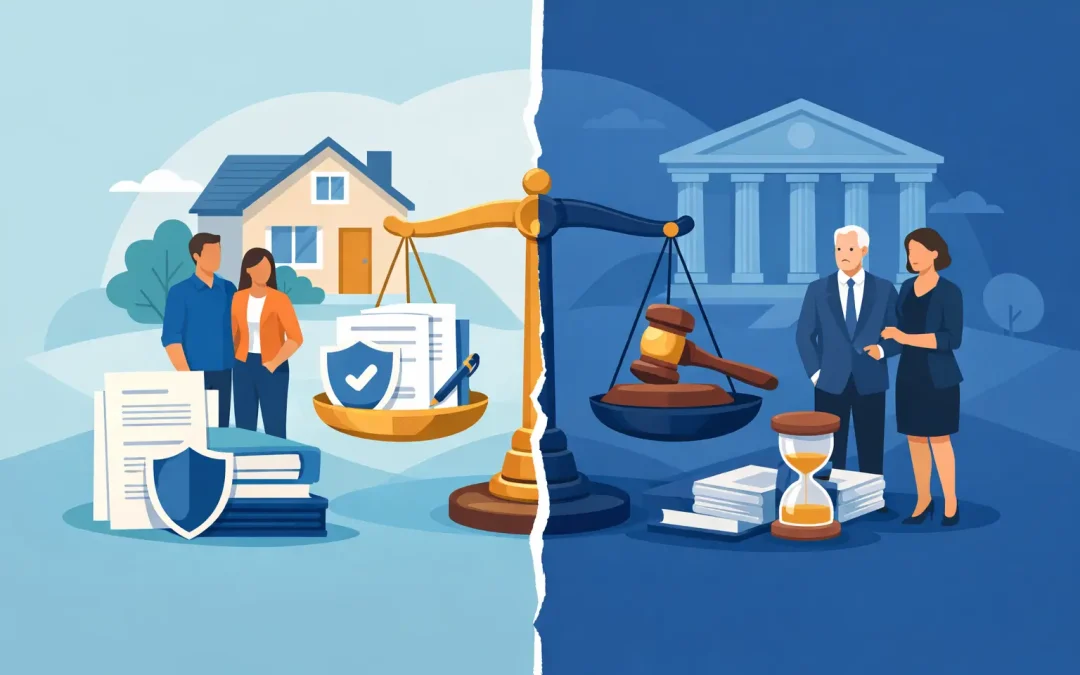
A home in your name, a bank account, a family business interest, and a clear set of wishes may still leave your loved ones with difficult administrative work after your death. The central question in a living trust versus probate decision is not simply whether one option is “better.” It is whether your assets, family circumstances, and goals call for a plan that can reduce court involvement while remaining practical to manage during your lifetime.
For many New Jersey families, a will and probate administration are entirely appropriate. For others, a properly prepared and funded revocable living trust can offer greater privacy, continuity, and convenience. The right answer depends on what you own, how it is titled, who will need to act for you, and the complexity your family may face.
Living Trust Versus Probate: The Basic Difference
Probate is the legal process of administering a deceased person’s estate. In New Jersey, the process generally begins when a will is submitted to the county Surrogate or, if there is no will, when an appropriate person seeks authority to administer the estate. The executor or administrator gathers assets, addresses valid debts and taxes, and distributes property to beneficiaries or heirs.
A revocable living trust is a legal arrangement created while you are alive. You typically serve as the initial trustee and retain control of the assets placed in the trust. You name a successor trustee to manage or distribute trust property after your death or if you become unable to manage your own affairs.
Assets owned by the trust generally pass under the terms of the trust rather than through probate. That distinction is meaningful, but it is not a complete estate plan by itself. A trust must be funded – meaning assets must actually be retitled into the trust when appropriate. Property left outside the trust may still require probate unless it passes by beneficiary designation, joint ownership, or another recognized transfer method.
What Probate Can Look Like in New Jersey
Probate is often discussed as though it is always costly, slow, and contentious. That is not the full picture. A straightforward New Jersey estate with a valid will, cooperative beneficiaries, and clearly identified assets may be administered efficiently. The Surrogate’s office can probate a will in many routine situations, although estate administration still requires careful attention to notices, creditors, tax filings, transfers, and final distributions.
Problems arise when an estate has unclear ownership, family disagreement, unpaid obligations, a contested will, property in multiple states, or a person who died without an effective plan. Those circumstances can add time, expense, and stress at a moment when family members are already grieving.
Probate also creates a public court record. While the details vary by filing and proceeding, a will submitted for probate and related estate documents may be accessible to the public. Families who value discretion, particularly those with substantial property holdings or closely held business interests, may prefer a structure that keeps more information out of the probate file.
A will remains valuable even when a trust is used. Most trust-based plans include a “pour-over” will. It directs assets that were not transferred to the trust during life to pass into the trust at death. Those assets may still need probate first, which is why updating titles and beneficiary designations is as important as signing the documents.
When a Living Trust May Be a Strong Fit
A living trust can be particularly useful when avoiding probate is a priority and there are assets that can be transferred into trust ownership. A New Jersey homeowner, for example, may place a residence in a revocable trust while retaining the ability to live in, sell, refinance, or otherwise manage the property during life. The successor trustee can then transfer or manage the home under the trust terms after death without relying on probate for that asset.
Trust planning may also make sense for people who own real estate in more than one state. Without trust planning, real property outside New Jersey may require a separate probate proceeding in the state where the property is located. Holding that property in a trust can help avoid this additional layer of administration.
Continuity during incapacity is another important benefit. If you become ill or unable to handle financial affairs, a successor trustee may step in under the trust document. A durable power of attorney is still an essential planning tool, but a trust can provide a clear path for the ongoing management of assets titled in the trust.
A trust can also give families more detailed instructions for staged distributions. Rather than leaving assets outright to a young adult beneficiary, you may direct a trustee to use funds for education, housing, health needs, or other support and distribute the remainder over time. This can be especially helpful when a beneficiary is young, financially inexperienced, receiving public benefits, or facing circumstances that call for careful oversight.
The Trade-Offs of a Living Trust
A living trust is not an automatic solution, and it does not eliminate every post-death responsibility. The successor trustee may still need to obtain date-of-death values, pay debts, prepare tax returns, communicate with beneficiaries, and complete property transfers. If a trust is challenged or poorly drafted, disputes can still occur.
There is also more work at the beginning. Real estate deeds may need to be prepared and recorded. Bank and brokerage accounts may need to be retitled. Business interests require a review of operating agreements, shareholder agreements, or transfer restrictions before being assigned to a trust. Failing to complete this work can undermine the primary reason for creating the trust.
Cost should be viewed in context. A trust-based plan often costs more to establish than a basic will, because it requires more documents, coordination, and follow-through. However, that upfront investment may be worthwhile when it reduces later administration burdens or prevents multi-state probate. For a person with a modest estate, simple assets, and beneficiaries who are aligned, a well-drafted will may be the more efficient choice.
A revocable living trust also does not, by itself, protect your assets from your creditors during your lifetime. Because you retain control of a revocable trust, the assets are generally still available to satisfy your obligations. It also does not automatically reduce income taxes or eliminate estate-related tax considerations. Tax results depend on the type of trust, the assets involved, and the applicable federal and New Jersey rules.
Asset Title Often Matters More Than the Document
Estate planning documents express your intentions, but asset ownership determines how many assets actually transfer. A retirement account with a valid beneficiary designation usually passes to that beneficiary outside probate. A jointly owned account may pass to the surviving owner, depending on the account arrangement. Life insurance generally passes by beneficiary designation.
On the other hand, a home titled solely in your name, an individual bank account with no payable-on-death designation, or a business interest without a succession plan may become probate assets. These details should be reviewed as part of the estate plan, not after a death occurs.
Beneficiary designations also need to work with the larger plan. Naming a minor child directly as a beneficiary can create complications because a minor generally cannot manage inherited funds. Naming an estate as the beneficiary of a retirement account may cause the account to flow through probate and may have tax consequences. A trust can be named in some circumstances, but the language must be coordinated carefully with the account and tax rules.
Questions That Help Determine the Right Approach
The decision is clearer when you look beyond the documents and consider your real-life needs. Are you concerned about keeping the transfer of your home private? Do you own property outside New Jersey? Would a successor need immediate authority to manage rental property, a business, or investments if you become incapacitated? Are your beneficiaries minors, blended-family members, or adults who may need structured support?
It is also worth considering the people you are asking to serve. An executor handles an estate through probate. A trustee manages trust property under the trust terms. Either role carries real responsibilities, and the person chosen should be trustworthy, organized, and willing to communicate. In some families, naming the same person to both roles is sensible. In others, separating the responsibilities can reduce conflict or place each task with the person best equipped to handle it.
Build a Plan Your Family Can Use
Estate planning is most effective when it gives the people you care about a workable path forward, not just a stack of signed papers. A will may be the right foundation. A living trust may provide added control and continuity. Many plans use both, along with powers of attorney, health care directives, and updated beneficiary designations.
Before choosing a path, gather your deed, account information, business documents, existing estate documents, and a clear list of the people you want to protect. A conversation with an estate planning attorney can turn those details into a plan that fits your family and your property. Scipio Law helps New Jersey clients evaluate those choices with practical, client-focused guidance, beginning with a no-charge 30-minute consultation.
Recent Comments